Table of Contents
1. First Formal Paper
2. Online Discussion Post
3. Blink Review
4. Imagination Free Write
5. Second Formal Paper
6. Final Class Reflection
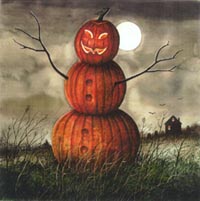
The Pumpkin Snowman
Danny Samuels
Warm grays flow through the night sky pierced by the shining moon. The back of the scene looks almost depressing. The picture is quite dark and bleak with no color to bring it to life. A small house protrudes from the ground, lit only by two lights in the windows. By the house the ground is cluttered by gravestones with bats flying high above. The bat's wings cut through the night sky like knives through butter. They fly watching below for anything that may be of interest. The ground is desolate, with very little life besides that of the grass, where even there the life is slowly withering away. Small pine trees line the horizon poking at the sky like toothpicks at a set of teeth. Their sharp blackness pushes them out further into the background environment.
And there he is.......... The pumpkin man. The centerpiece of the scene. He glows with a warm orange that makes him pop from the scene and seem almost real, as though he could be touched. His eyes look as though he is lit from the inside. What could create such a light? Could it be a mysterious occult inhabitant? Or might it just be a candle at the bottom of it's hollow belly. This erie snowman of sorts is made up of three pumpkins with buttons carved away from his flesh. Jagged sticks poke out from the middle pumpkin and act as crude arms. A creepy cracked smile spreads through the upper pumpkin creating a face that puts the viewer at unease. Although he is smiling he is almost emotionless.
The crude snowman, made of not snow but pumpkins, sits waiting. It is impossible to tell what exactly he is waiting for. It could be many things or it could be one thing. His intentions are not readable as his face is lacking of concrete emotion to guess upon. He could be waiting for his prey to come close, unknowing of their impending doom. He could be staring into the strange horizon looking for something to intrigue him and trigger his imagination. He could even be contemplating the meaning of life and the answers to all of the universe's questions. As one knows, no one is a mind reader. We can sometimes come close through reading facial expressions, but as this strange snowman shows no recognizable emotion we are not able to guess everything he is thinking. All we can do is contemplate as the snowman sits waiting.
Work Cited
Minor, Wendell. The Pumpkin Snowman. Watercolor. Selby Gallery, Sarasota, Florida.
Discussion Post
Bruce Catton had a very effective approach to comparing Grant vs. Lee. He starts by laying in a few similarities and giving a brief history of the setting which acts as his hook statement. He then goes on to talk about the vast differences between the two generals followed by the few similarities to tie it all together. It has a good flow and works well to keep the reader interested in the paper, as you are constantly hearing new facts.
The entire setup of Catton's essay is effective. The introduction pulls you in and the conclusion ties everything together and makes the essay coherent. Overall it is a very effective format that worked well comparing two vastly different people.
I found neat vs. sloppy people to be grossly exaggerated. Both sides seemed to be taken to high almost OCD extremes. It was decent comparison but overly twisted to try to make a stronger point. One of the pieces that stuck in my head was the scene revolving around the black plague with the man showing off his splotchy leg that was distorted because of the plague. One interesting thing i found out about the time of the black plague was the bewilderment of society as they tried to understand what was causing the epidemic. Some blamed rats, some blamed their sins, and some even blamed the Jews. No one really new what was causing it. A good piece to compare to the one in the museum would be the photo on page 528 of convergences. The piece shows what looks like a cold disgruntled homeless man sitting on a bench at a street corner. Both pieces show sadness, sickness, and poverty. They also both have a central subject figure, both of which seem to be in pain. My main point would be that even though both pictures are different, I mean one is a photo and one is an old painting both featuring different subject matter, but as one looks deep inside and sees the emotion lying in the faces and bodies of the two figures, one can see they are vastly similar.
Blink
Danny Samuels
Overall I found Blink to be a useless repetitive read. Yes blink did have it's interesting points but overall it seemed the author said the same thing over and over again in different ways. One can get most of the meaning of the book by reading the first two chapters. Chapter six is also moderately important because it talks about the downside of thin slicing, also someone gets shot, which also makes things more interesting. Otherwise though the rest of the chapters have nothing new that one can learn from them. It seems as though, as the book went on, that the author was just trying to flaunt his knowledge and fuel his ego. Although in the first few beginning chapters there were some quite interesting points brought up such as the prospective use and power of thin slicing and snap judgements, which were intellectual weapons I had never heard of or thought about before. But after the first few chapters and examples the reader can definitely grasp that power and the rest of the book is really very useless in my opinion almost acts as overkill. All in all I found this book to be interesting through only about one quarter of the “action” and the rest is pretty needless.

Imagination
Imagination is quite a strange puzzle. It is hard to place one's finger exactly on a definition that can fully describe what imagination is. It can be defined as a persons subconscious thoughts and dreams, or a place one goes to escape the blandness of every day life. It is almost impossible to define. One thing that is for certain is that the need for a person to escape the dreariness of every day life to a world of fantastical wonderment is directly related to the advancement in technology.
As technology progressed throughout history the possibilities for an escape from reality became much more accessible. It can be traced all the way back to the days of Hieronymus Bosch where you can easily see from his paintings of demons and monsters that he wanted to express his imagination. Yet back then all art had to be justified through some sort of religious aspect. So therefore, although miniscule, there was always some sort of a religious theme within his paintings. The next big evolution in imaginative expression the invention of the printing press and the ability to print novels where then everyone, not just the rich, had the ability to purchase and read stories. Another huge advancement was the ability to print color covers on those novels. Now the viewer could get a real glimpse into what the author was trying to portray. This also gave many fantasy artists such as the great Frank Frazetta their starts. Then along came the comic book industry, which allowed the viewer to see a visual interpretation of what before he could only imagine. One great influential figure in that industry was Jack Kirby who created the image of many of the great heroes of today such as the fantastic four and the silver surfer. The next and possibly biggest boom in the industry were movies and video games. These have, in recent years, become so believable that it really seems like one could have their own place within the story. It really acts as a great escape where a person can forget their worries and escape to their own fictional world. It is hard to argue that imagination is not directly correlated with technology.
