Samuels 1
Danny Samuels
Akeyla Silver
Writing Studio
25 October 2009
The Four Freedoms
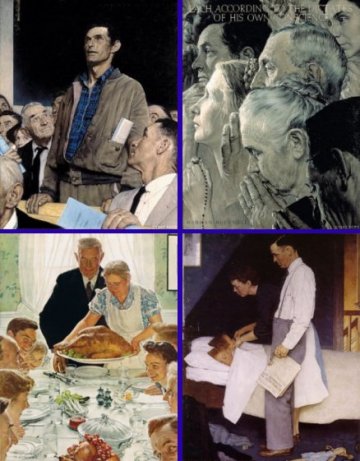
On January 6th, 1941 Franklin Roosevelt stood before the 77th Congress of the United States and delivered a speech now known as the four freedoms speech. The speech came about in a time of crisis in the United States. World War II was in full fledged chaos and the American people needed something to bring them hope and remind them what they were fighting for. In the speech Franklin Roosevelt stated the four concrete freedoms that make America one of the greatest and most powerful countries in the world. These are: freedom of speech, freedom of worship, freedom from want and freedom from fear. These are the protected, innate rights of being an American citizen and this speech served as a reminder to those why they must keep fighting to maintain those rights. Norman Rockwell was the lead cover illustrator for the saturday evening post at the time and in 1943 he painted four of his most well known paintings. Using interesting characters based off every day people he portrayed the four freedoms in four separate 46” by 36” paintings. These paintings were posted all over the United States. Not only did the paintings help to raise $132 million dollars in war-bonds they also helped to inspire an entire nation in a time of crisis. It is mind boggling how simple paintings based off of a short section of a speech could open the eyes of one of the most powerful and influential countries in the entire world.
America was facing one of the most critical points in its entire history. World War II was ravaging the world and America was quickly sucked into the fray. It was a dark time of pain, stress and constant fear. Most of Europe was owned by Nazi tyranny and a replenishing of hope seemed to be needed. On January 6th, 1941 Franklin Roosevelt delivered his message not only to congress but also to
Samuels 1
the American people.
“In the future days which we seek to make secure, we look forward to a world founded upon four essential human freedoms.
The first is freedom of speech and expression -- everywhere in the world.
The second is freedom of every person to worship God in his own way -- everywhere in the world.
The third is freedom from want, which, translated into world terms, means economic understandings which will secure to every nation a healthy peacetime life for its inhabitants -- everywhere in the world.
The fourth is freedom from fear, which, translated into world terms, means a world-wide reduction of armaments to such a point and in such a thorough fashion that no nation will be in a position to commit an act of physical aggression against any neighbor -- anywhere in the world.
That is no vision of a distant millennium. It is a definite basis for a kind of world attainable in our own time and generation. That kind of world is the very antithesis of the so-called "new order" of tyranny which the dictators seek to create with the crash of a bomb.
Franklin Delano Roosevelt, excerpted from the Annual Message to the Congress, January 6, 1941
These rights are what make America what it is and what makes it one of the greatest countries in the world. These four freedoms are what America fights for, has upheld, and have defined an integral part of what our government is. This speech became a very important speech in the history of America's part in WWII. Yet more was needed to inspire and re-moralize the people of the United States.
Norman Rockwell by this time was too old to join the army and help fight so he decided to do the four paintings in an effort to raise money and awareness for the war. He found it so important that he worked tirelessly for six months straight until they were done, losing fifteen pounds in the process. He wanted to find a wartime sponsor for these paintings to help spread the message around the country but as much as he tried no one wanted to pick the paintings up. Norman Rockwell was forced to turn back to his old reliable source, The Saturday Evening Post. It turned out to be a good choice as the
Samuels 1
popularity of the pieces boomed and soon after the articles were printed, over 25,000 readers of the magazine ordered sets of prints from the magazine.
Roosevelt stated in his speech that every person has the right to the freedom of speech and expression in their own way. In Rockwell's painting a man is shown speaking up without interruption or any form of harassment. He is a working man as one can see from his ragged hands and normal everyday clothing. He is standing, speaking up with all of the the others staring and listening intently with looks of understanding and appreciation on their faces. This painting clearly puts Roosevelt's words into a visual scene that clearly tells a story. The message that Roosevelt was trying to portray was clearly illustrated showing the similarities between the world of illustration and the written word, where even the smallest and simplest sentence can be perceived in a visual and dramatic way.
Religion is an integral part of American society. The freedom to worship God in ones own way is a very important right to the American citizen. In the painting of Freedom to Worship it shows a crowd of people praying close together. The people are of all different ages spread throughout the picture praying to their own god. The fact that there is no religion considered “right” is part of what makes our country the land of the free and is truly something that should be fought for. In this painting it shows a group of people praying together in unity, where not one looks as though he is being persecuted by anyone else for his beliefs. This is what Roosevelt was trying to say about being able to worship together in a person's own way without any torment from others. These characters are so believable as every day people that the viewer is thrust into the scene and feels a real connection with the piece. This is what made these pieces so effective at inspiring and raising awareness and money for the war effort. People feel as though it is easier to support something they can connect to.
Samuels 1
Everyone deserves to live a healthy life free from huge economic restrictions. They should have equal rights to be successful at what they do and make their living doing what is right for them. Freedom from Want is the third of the four freedoms painted by Rockwell. It shows a family centered around the dinner table eating a delicious looking dinner. The family members are all wearing nice clothes and there is no sign of poverty anywhere in the painting. In the speech it stated that everyone was entitled to live a nice life like this not just certain chosen people. Everyone has the right to be able to get what they need to be able to live a happy, prosperous life. Rockwell's painting shows a family doing just that, which gives people hope that they to will be able to in the future, or continue to, live a life like that of the family in the painting.
The last of the series of four paintings by Rockwell was the painting expressing Freedom from Fear. At this period in American history violence was running rampant. People should be able to live their life free from the thought that at any second they may be attacked. Roosevelt was calling for a worldwide reduction in arms so that no country was in a position to violently overwhelm another. This message is expressed through a simple scene showing two siblings sleeping as their parents tuck them into bed. The father is holding a newspaper announcing even more bombings around the world. Although the setting and time is dark the children are sleeping peacefully, without any form of fear expressed across their faces. Even through the darkest of times these children still seem to look peaceful. “Peaceful” is the key word in that sentence, and that was what Rockwell was trying to convey and bring about through this painting and any of the other three, a true feeling of peace in America and throughout the world.
The Four Freedoms paintings became so vastly popular that the US Treasury Department, with the help of Curtis Publishing, created the Four Freedoms War Bond Show. People had only seen these
Samuels 1
amazing paintings printed in magazines or on posters but now with the start of this show they were now able to see the paintings in person as they were toured around the country. The paintings were toured through 16 different cities and well over a million people showed up to see them, raising more then 130 million dollars in war bonds. The paintings touched people on a personal level and brought about feelings thought essential to the free people of America.
One of the most effective things about these paintings was the reaction or snap judgement that occurred when first looking at the pieces. When looking at these paintings the separate messages that Rockwell tried to show are quite obvious. In other words, for example, when looking at the freedom of speech paintings one of the first things that pops into the viewers head is that message of freedom that is so important to every citizen of America. This instant reaction is part of what makes these paintings so effective at connecting with the viewer. By looking at these paintings for only a matter of seconds one can already guess the meaning of what the painting is trying to show.
Paintings can be more important than one might think. They can inspire and sway the world sometimes even more than words. Both the speech and the four paintings have become icons in American history. The paintings are as well known as any image produced during WWII and have even been compared to the photo of the marines raising the flag over Iwo Jima. Illustrations not only tell stories, they can create emotion and inspire people to do great things. They can re-moralize a country and even raise phenomenal amounts of money for the government. All in all paintings and words are not all too different. They both tell stories, they both make a point, and they can both touch people on deep emotional levels. It is all about how they are delivered that makes the difference.
Samuels 1
Work Cited
Norman Rockwell Museum. “Norman Rockwell's Four Freedoms: Paintings That Inspired a Nation.” Traditional Fine Arts Organization. 10/26/2009 < http://www.tfaoi.com/aa/4aa/4aa380.htm>.
Author Unknown. “Norman Rockwell's Four Freedoms.” Best Norman Rockwell Art. 10/25/2009 <http://www.best-norman-rockwell-art.com/four-freedoms.html>.
Hennessey, Maureen, and Anne Knutson. Norman Rockwell Pictures for the American People. New York: Harry N. Abrams, Inc, 1999.
Author Unknown. “Norman Rockwell Museum.” Blog. 10/27/2009
