Table of Contents
1. First Formal Paper
2. Online Discussion Post
3. Blink Review
4. Imagination Free Write
5. Second Formal Paper
6. Final Class Reflection
The Pumpkin Snowman
Danny Samuels
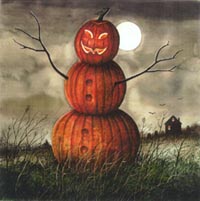
Warm grays flow through the night sky pierced by the shining moon. The back of the scene looks almost depressing. The picture is quite dark and bleak with no color to bring it to life. A small house protrudes from the ground, lit only by two lights in the windows. By the house the ground is cluttered by gravestones with bats flying high above. The bat's wings cut through the night sky like knives through butter. They fly watching below for anything that may be of interest. The ground is desolate, with very little life besides that of the grass, where even there the life is slowly withering away. Small pine trees line the horizon poking at the sky like toothpicks at a set of teeth. Their sharp blackness pushes them out further into the background environment.
And there he is.......... The pumpkin man. The centerpiece of the scene. He glows with a warm orange that makes him pop from the scene and seem almost real, as though he could be touched. His eyes look as though he is lit from the inside. What could create such a light? Could it be a mysterious occult inhabitant? Or might it just be a candle at the bottom of it's hollow belly. This erie snowman of sorts is made up of three pumpkins with buttons carved away from his flesh. Jagged sticks poke out from the middle pumpkin and act as crude arms. A creepy cracked smile spreads through the upper pumpkin creating a face that puts the viewer at unease. Although he is smiling he is almost emotionless.
The crude snowman, made of not snow but pumpkins, sits waiting. It is impossible to tell what exactly he is waiting for. It could be many things or it could be one thing. His intentions are not readable as his face is lacking of concrete emotion to guess upon. He could be waiting for his prey to come close, unknowing of their impending doom. He could be staring into the strange horizon looking for something to intrigue him and trigger his imagination. He could even be contemplating the meaning of life and the answers to all of the universe's questions. As one knows, no one is a mind reader. We can sometimes come close through reading facial expressions, but as this strange snowman shows no recognizable emotion we are not able to guess everything he is thinking. All we can do is contemplate as the snowman sits waiting.
Work Cited
Minor, Wendell. The Pumpkin Snowman. Watercolor. Selby Gallery, Sarasota, Florida.
Discussion Post
Bruce Catton had a very effective approach to comparing Grant vs. Lee. He starts by laying in a few similarities and giving a brief history of the setting which acts as his hook statement. He then goes on to talk about the vast differences between the two generals followed by the few similarities to tie it all together. It has a good flow and works well to keep the reader interested in the paper, as you are constantly hearing new facts.
The entire setup of Catton's essay is effective. The introduction pulls you in and the conclusion ties everything together and makes the essay coherent. Overall it is a very effective format that worked well comparing two vastly different people.
I found neat vs. sloppy people to be grossly exaggerated. Both sides seemed to be taken to high almost OCD extremes. It was decent comparison but overly twisted to try to make a stronger point. One of the pieces that stuck in my head was the scene revolving around the black plague with the man showing off his splotchy leg that was distorted because of the plague. One interesting thing i found out about the time of the black plague was the bewilderment of society as they tried to understand what was causing the epidemic. Some blamed rats, some blamed their sins, and some even blamed the Jews. No one really new what was causing it. A good piece to compare to the one in the museum would be the photo on page 528 of convergences. The piece shows what looks like a cold disgruntled homeless man sitting on a bench at a street corner. Both pieces show sadness, sickness, and poverty. They also both have a central subject figure, both of which seem to be in pain. My main point would be that even though both pictures are different, I mean one is a photo and one is an old painting both featuring different subject matter, but as one looks deep inside and sees the emotion lying in the faces and bodies of the two figures, one can see they are vastly similar.
Blink
Danny Samuels
Overall I found Blink to be a useless repetitive read. Yes blink did have it's interesting points but overall it seemed the author said the same thing over and over again in different ways. One can get most of the meaning of the book by reading the first two chapters. Chapter six is also moderately important because it talks about the downside of thin slicing, also someone gets shot, which also makes things more interesting. Otherwise though the rest of the chapters have nothing new that one can learn from them. It seems as though, as the book went on, that the author was just trying to flaunt his knowledge and fuel his ego. Although in the first few beginning chapters there were some quite interesting points brought up such as the prospective use and power of thin slicing and snap judgements, which were intellectual weapons I had never heard of or thought about before. But after the first few chapters and examples the reader can definitely grasp that power and the rest of the book is really very useless in my opinion almost acts as overkill. All in all I found this book to be interesting through only about one quarter of the “action” and the rest is pretty needless.

Imagination
Imagination is quite a strange puzzle. It is hard to place one's finger exactly on a definition that can fully describe what imagination is. It can be defined as a persons subconscious thoughts and dreams, or a place one goes to escape the blandness of every day life. It is almost impossible to define. One thing that is for certain is that the need for a person to escape the dreariness of every day life to a world of fantastical wonderment is directly related to the advancement in technology.
As technology progressed throughout history the possibilities for an escape from reality became much more accessible. It can be traced all the way back to the days of Hieronymus Bosch where you can easily see from his paintings of demons and monsters that he wanted to express his imagination. Yet back then all art had to be justified through some sort of religious aspect. So therefore, although miniscule, there was always some sort of a religious theme within his paintings. The next big evolution in imaginative expression the invention of the printing press and the ability to print novels where then everyone, not just the rich, had the ability to purchase and read stories. Another huge advancement was the ability to print color covers on those novels. Now the viewer could get a real glimpse into what the author was trying to portray. This also gave many fantasy artists such as the great Frank Frazetta their starts. Then along came the comic book industry, which allowed the viewer to see a visual interpretation of what before he could only imagine. One great influential figure in that industry was Jack Kirby who created the image of many of the great heroes of today such as the fantastic four and the silver surfer. The next and possibly biggest boom in the industry were movies and video games. These have, in recent years, become so believable that it really seems like one could have their own place within the story. It really acts as a great escape where a person can forget their worries and escape to their own fictional world. It is hard to argue that imagination is not directly correlated with technology.
Samuels 1
Danny Samuels
Akeyla Silver
Writing Studio
25 October 2009
The Four Freedoms
On January 6th, 1941 Franklin Roosevelt stood before the 77th Congress of the United States and delivered a speech now known as the four freedoms speech. The speech came about in a time of crisis in the United States. World War II was in full fledged chaos and the American people needed something to bring them hope and remind them what they were fighting for. In the speech Franklin Roosevelt stated the four concrete freedoms that make America one of the greatest and most powerful countries in the world. These are: freedom of speech, freedom of worship, freedom from want and freedom from fear. These are the protected, innate rights of being an American citizen and this speech served as a reminder to those why they must keep fighting to maintain those rights. Norman Rockwell was the lead cover illustrator for the saturday evening post at the time and in 1943 he painted four of his most well known paintings. Using interesting characters based off every day people he portrayed the four freedoms in four separate 46” by 36” paintings. These paintings were posted all over the United States. Not only did the paintings help to raise $132 million dollars in war-bonds they also helped to inspire an entire nation in a time of crisis. It is mind boggling how simple paintings based off of a short section of a speech could open the eyes of one of the most powerful and influential countries in the entire world.
America was facing one of the most critical points in its entire history. World War II was ravaging the world and America was quickly sucked into the fray. It was a dark time of pain, stress and constant fear. Most of Europe was owned by Nazi tyranny and a replenishing of hope seemed to be needed. On January 6th, 1941 Franklin Roosevelt delivered his message not only to congress but also to
Samuels 1
the American people.
“In the future days which we seek to make secure, we look forward to a world founded upon four essential human freedoms.
The first is freedom of speech and expression -- everywhere in the world.
The second is freedom of every person to worship God in his own way -- everywhere in the world.
The third is freedom from want, which, translated into world terms, means economic understandings which will secure to every nation a healthy peacetime life for its inhabitants -- everywhere in the world.
The fourth is freedom from fear, which, translated into world terms, means a world-wide reduction of armaments to such a point and in such a thorough fashion that no nation will be in a position to commit an act of physical aggression against any neighbor -- anywhere in the world.
That is no vision of a distant millennium. It is a definite basis for a kind of world attainable in our own time and generation. That kind of world is the very antithesis of the so-called "new order" of tyranny which the dictators seek to create with the crash of a bomb.
Franklin Delano Roosevelt, excerpted from the Annual Message to the Congress, January 6, 1941
These rights are what make America what it is and what makes it one of the greatest countries in the world. These four freedoms are what America fights for, has upheld, and have defined an integral part of what our government is. This speech became a very important speech in the history of America's part in WWII. Yet more was needed to inspire and re-moralize the people of the United States.
Norman Rockwell by this time was too old to join the army and help fight so he decided to do the four paintings in an effort to raise money and awareness for the war. He found it so important that he worked tirelessly for six months straight until they were done, losing fifteen pounds in the process. He wanted to find a wartime sponsor for these paintings to help spread the message around the country but as much as he tried no one wanted to pick the paintings up. Norman Rockwell was forced to turn back to his old reliable source, The Saturday Evening Post. It turned out to be a good choice as the
Samuels 1
popularity of the pieces boomed and soon after the articles were printed, over 25,000 readers of the magazine ordered sets of prints from the magazine.
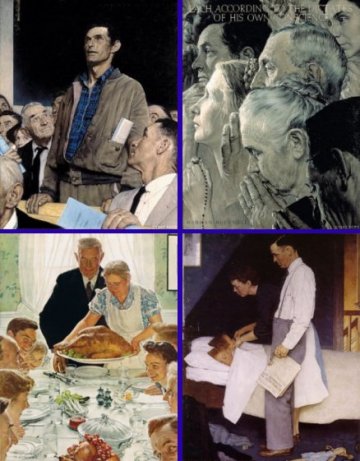
Roosevelt stated in his speech that every person has the right to the freedom of speech and expression in their own way. In Rockwell's painting a man is shown speaking up without interruption or any form of harassment. He is a working man as one can see from his ragged hands and normal everyday clothing. He is standing, speaking up with all of the the others staring and listening intently with looks of understanding and appreciation on their faces. This painting clearly puts Roosevelt's words into a visual scene that clearly tells a story. The message that Roosevelt was trying to portray was clearly illustrated showing the similarities between the world of illustration and the written word, where even the smallest and simplest sentence can be perceived in a visual and dramatic way.
Religion is an integral part of American society. The freedom to worship God in ones own way is a very important right to the American citizen. In the painting of Freedom to Worship it shows a crowd of people praying close together. The people are of all different ages spread throughout the picture praying to their own god. The fact that there is no religion considered “right” is part of what makes our country the land of the free and is truly something that should be fought for. In this painting it shows a group of people praying together in unity, where not one looks as though he is being persecuted by anyone else for his beliefs. This is what Roosevelt was trying to say about being able to worship together in a person's own way without any torment from others. These characters are so believable as every day people that the viewer is thrust into the scene and feels a real connection with the piece. This is what made these pieces so effective at inspiring and raising awareness and money for the war effort. People feel as though it is easier to support something they can connect to.
Samuels 1
Everyone deserves to live a healthy life free from huge economic restrictions. They should have equal rights to be successful at what they do and make their living doing what is right for them. Freedom from Want is the third of the four freedoms painted by Rockwell. It shows a family centered around the dinner table eating a delicious looking dinner. The family members are all wearing nice clothes and there is no sign of poverty anywhere in the painting. In the speech it stated that everyone was entitled to live a nice life like this not just certain chosen people. Everyone has the right to be able to get what they need to be able to live a happy, prosperous life. Rockwell's painting shows a family doing just that, which gives people hope that they to will be able to in the future, or continue to, live a life like that of the family in the painting.
The last of the series of four paintings by Rockwell was the painting expressing Freedom from Fear. At this period in American history violence was running rampant. People should be able to live their life free from the thought that at any second they may be attacked. Roosevelt was calling for a worldwide reduction in arms so that no country was in a position to violently overwhelm another. This message is expressed through a simple scene showing two siblings sleeping as their parents tuck them into bed. The father is holding a newspaper announcing even more bombings around the world. Although the setting and time is dark the children are sleeping peacefully, without any form of fear expressed across their faces. Even through the darkest of times these children still seem to look peaceful. “Peaceful” is the key word in that sentence, and that was what Rockwell was trying to convey and bring about through this painting and any of the other three, a true feeling of peace in America and throughout the world.
The Four Freedoms paintings became so vastly popular that the US Treasury Department, with the help of Curtis Publishing, created the Four Freedoms War Bond Show. People had only seen these
Samuels 1
amazing paintings printed in magazines or on posters but now with the start of this show they were now able to see the paintings in person as they were toured around the country. The paintings were toured through 16 different cities and well over a million people showed up to see them, raising more then 130 million dollars in war bonds. The paintings touched people on a personal level and brought about feelings thought essential to the free people of America.
One of the most effective things about these paintings was the reaction or snap judgement that occurred when first looking at the pieces. When looking at these paintings the separate messages that Rockwell tried to show are quite obvious. In other words, for example, when looking at the freedom of speech paintings one of the first things that pops into the viewers head is that message of freedom that is so important to every citizen of America. This instant reaction is part of what makes these paintings so effective at connecting with the viewer. By looking at these paintings for only a matter of seconds one can already guess the meaning of what the painting is trying to show.
Paintings can be more important than one might think. They can inspire and sway the world sometimes even more than words. Both the speech and the four paintings have become icons in American history. The paintings are as well known as any image produced during WWII and have even been compared to the photo of the marines raising the flag over Iwo Jima. Illustrations not only tell stories, they can create emotion and inspire people to do great things. They can re-moralize a country and even raise phenomenal amounts of money for the government. All in all paintings and words are not all too different. They both tell stories, they both make a point, and they can both touch people on deep emotional levels. It is all about how they are delivered that makes the difference.
Samuels 1
Work Cited
Norman Rockwell Museum. “Norman Rockwell's Four Freedoms: Paintings That Inspired a Nation.” Traditional Fine Arts Organization. 10/26/2009 < http://www.tfaoi.com/aa/4aa/4aa380.htm>.
Author Unknown. “Norman Rockwell's Four Freedoms.” Best Norman Rockwell Art. 10/25/2009 <http://www.best-norman-rockwell-art.com/four-freedoms.html>.
Hennessey, Maureen, and Anne Knutson. Norman Rockwell Pictures for the American People. New York: Harry N. Abrams, Inc, 1999.
Author Unknown. “Norman Rockwell Museum.” Blog. 10/27/2009
Writing Reflection
I feel as though I have improved steadily during my time throughout writing studio at Ringling College of Art and Design. I believe I have been on the same literary skill level for a good while now but before could always get away without fully utilizing it. College though, is not a place to not give 100%. This class made me feel like I really can be an excellent writer when I actually take the time and write something to the best of my ability. Now I do not feel like I have learned much on the side of technical writing skill but I think I have learned how to best utilize the skills that I already have. Although I do not feel as though I have learned much in the way of technical writing skills I do feel like I have grown as a writer. I pushed myself on everything I wrote and now am much more confident in my writing abilities.
The three formal papers where all very different and worked the writers mind in different ways. I found the hardest of the three to be the second formal paper. It was a long term comparative research paper and was much more demanding than the past few papers. I found the most enjoyable formal paper to the first where we had to describe a piece of art work in beautiful, descriptive, flowing language. I found it fun to be able to use my imagination and describe in a creative way what was going on in the picture. The formal papers where the main assignments, since they lasted longer, that I feel helped me improve the most as a writer.
Now one thing I disliked from the class were the online discussion posts. I felt as though the system was buggy and annoying to use and I found the online readings that we were meant to discuss were drab and repetitive. The group and individual presentations were unenjoyable as well. I think the class did not spend as much time preparing for them as they should have and thus they were slightly juvenile and only scratched the surface of the topic they were presenting.
The final portfolio criteria was clear as day. It said exactly what items to put online. The guidelines for the portfolio were actually great. They were simple and made it easy to choose what pieces. As writer I am picky about what work I feel was successful so it was not hard to choose what pieces to put online.
Overall my experience in writing studio was good. It pushed me as a writer while at the same time not taking up all my time that I could be doing art. I feel more confident in my writing and know that I have the ability now to write an excellent work of literature. The projects were clear and overall interesting. I do not have many complaints about writing studio and Ringling College of Art and Design.
